How to Take
This product is intended for adults only.
Do not use in case of individual intolerance or hypersensitivity to any of the product’s components or If you are taking antidepressants or other medications that affect the serotonin system.
Do not use during pregnancy or breastfeeding.
Consult a healthcare professional before use.
Not intended to treat diseases.
Active Substances
Calea zacatechichi — Calea
A Mexican “dream herb” traditionally used by the Chontal people to seek signs and answers through dreams. Calea gives the formula its dream-oriented dimension — inner imagery and the ability to remember it.
Silene capensis — African Dream Root
In Xhosa tradition, dreaming was regarded not simply as a nighttime event, but as a space for connection with ancestors and inner knowledge. The root was used to promote more vivid and memorable dreams.
Bacopa monnieri — Bacopa
A bacoside-rich plant regarded in Ayurvedic tradition as one of the principal herbs associated with the mind and memory. In modern research, its most consistent effects are associated with memory and the recall of information.
Centella asiatica — Gotu Kola
Known in Ayurveda as Mandukaparni, it belongs to the Medhya Rasayana group of plants traditionally associated with mental clarity and memory. Its principal active compounds are triterpenes, including asiaticoside, madecassoside, and related derivatives.
5-HTP — 5-Hydroxytryptophan
A direct precursor to serotonin. Serotonin is subsequently used in the synthesis of melatonin. Through this pathway, 5-HTP connects the nighttime aspect of the formula with the natural serotonin–melatonin biochemical cycle.
Detailed description
🔮 The Third Eye — Symbol of Inner Vision
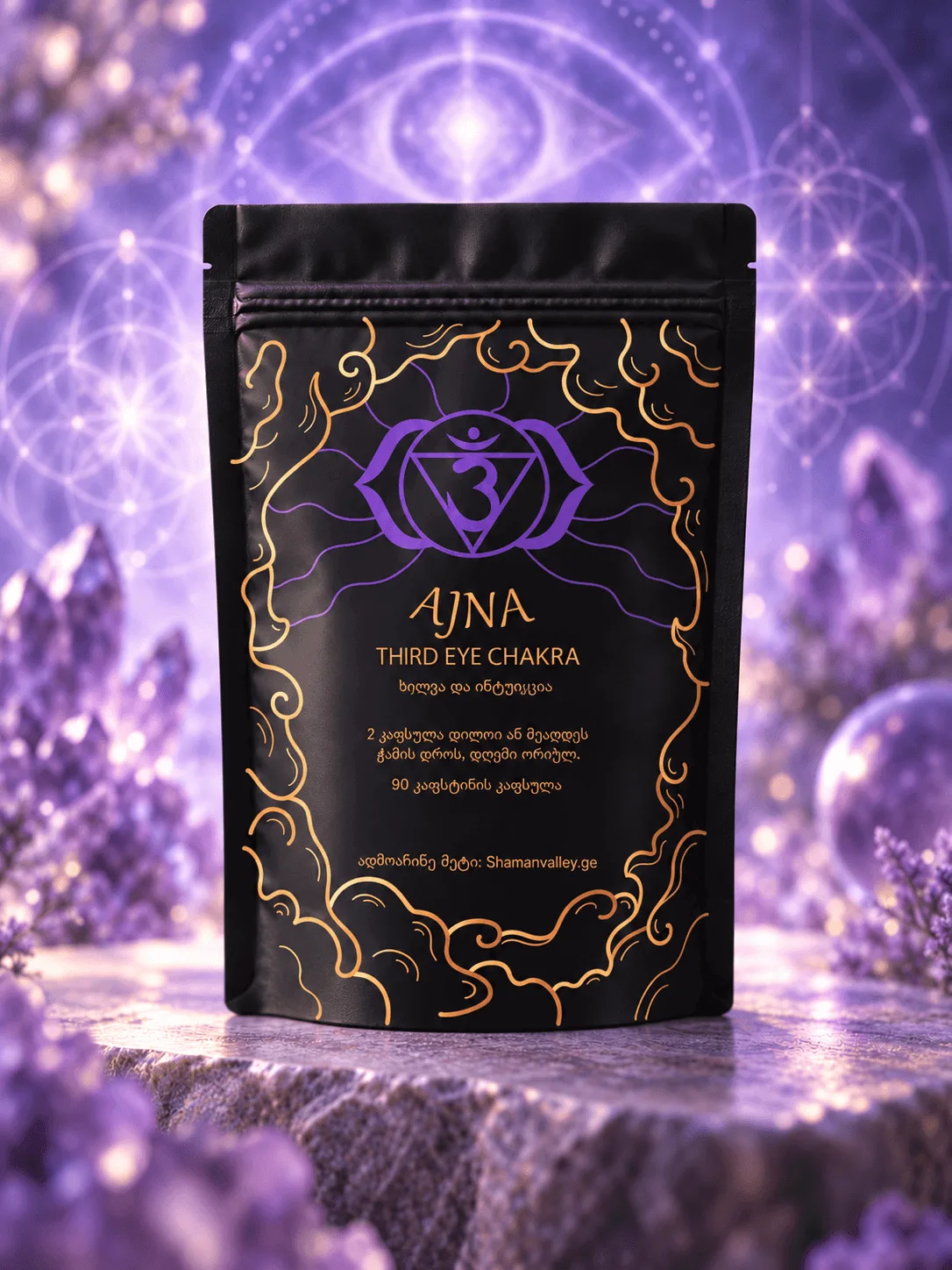
The Sanskrit word Ajna means “command,” “authority,” or “command center.” In Tantric tradition, it is represented as a two-petaled lotus between the eyebrows — a center associated with the mind, inner knowledge, and vision beyond ordinary perception. Its seed mantra is OM.
The “third eye” is therefore more than a metaphor for mystical sight. It represents the ability to see not only an object, but its meaning — to recognize connections, draw on previous experience, distinguish signal from noise, and form an inner image before it becomes language.
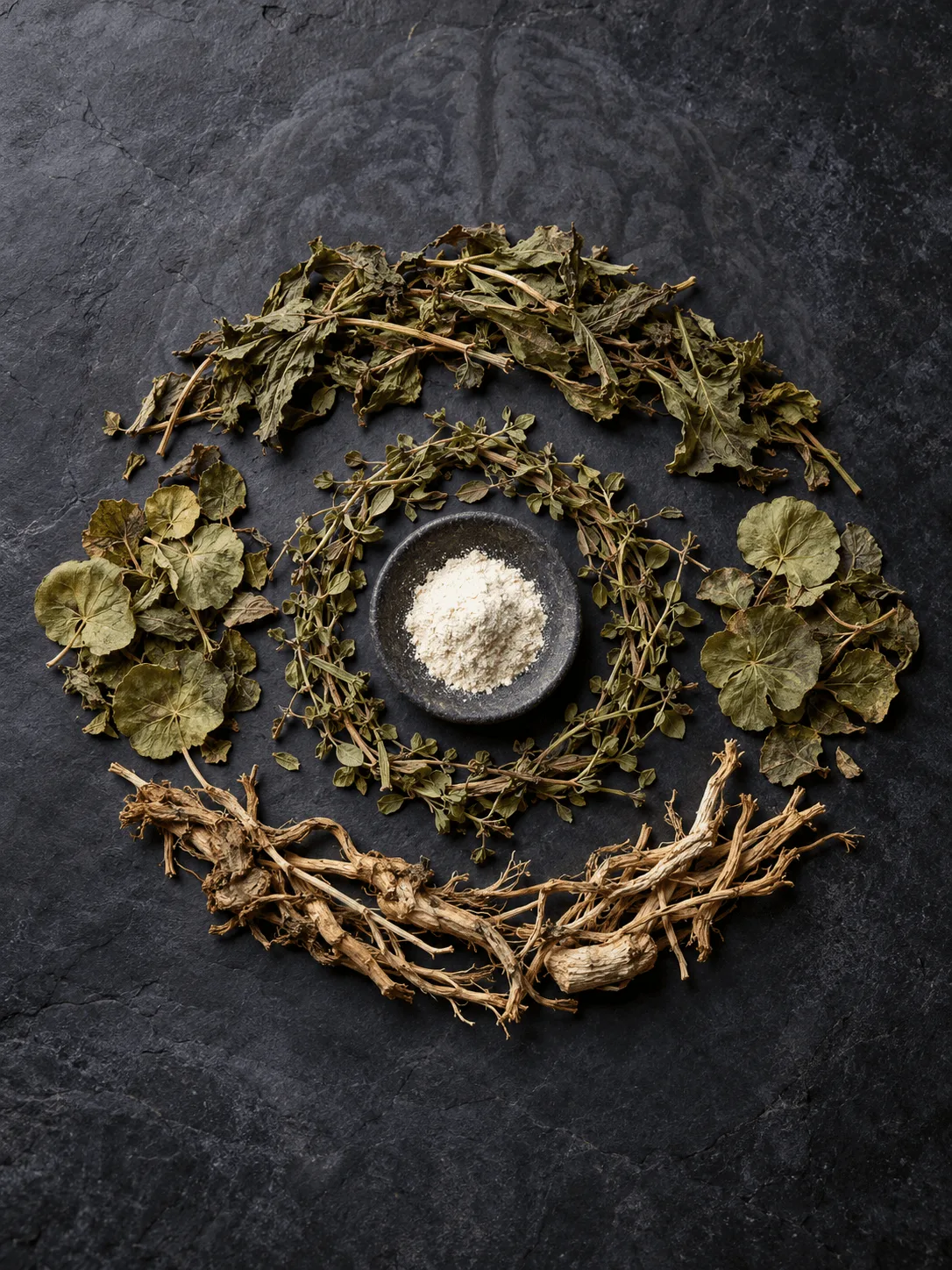
The plants in the formula reflect the same symbolism across different traditions. In the Mexican Chontal tradition, Calea was associated with receiving answers through dreams; in South African Xhosa practice, Silene was linked with ancestral connection and inner knowledge through dreaming; in Indian tradition, Bacopa and Gotu Kola were associated with the mind, memory, and meditative clarity. These traditions differ, but they share one underlying idea: the mind does not merely receive information — it learns how to see it.
🧠 Ajna: Neurochemistry and Mechanisms of Action
Memory and Attention — Bacopa monnieri
Biochemistry:
The principal active compounds in Bacopa are bacosides. They influence several processes, including cholinergic transmission, synaptic plasticity, antioxidant protection of neural tissue, and hippocampal processes involved in memory formation.
In studies, regular Bacopa supplementation improved the retention of newly learned information and its subsequent recall, as well as the ability to sustain attention.
Effect:
Within the formula, Bacopa provides a foundation for retaining and retrieving information — allowing experience to be stored more effectively and accessed later.
Mental Stability — Gotu Kola
Biochemistry:
The main bioactive compounds in Centella asiatica include asiaticoside, madecassoside, asiatic acid, and madecassic acid. These triterpenes influence antioxidant, inflammatory, and mitochondrial processes and support the protection of neural tissue.
Studies of Gotu Kola have reported changes related to attentiveness and general improvements in mood.
Effect:
Within the formula, Gotu Kola creates a calmer and more stable mental background — a state in which attention is less easily scattered and information can be processed in a more organized way.
Dream Imagery — Calea zacatechichi
Biochemistry:
Calea contains sesquiterpene lactones, germacranolides, and flavonoids. In a controlled study, it increased periods of lighter sleep and spontaneous awakenings, while participants reported dreams and hypnagogic imagery significantly more often.
Calea also increased fast 31–50 Hz hippocampal gamma activity during REM sleep. The hippocampus plays an important role in memory and the contextual organization of experience, while gamma rhythms are associated with the integration of neural information.
Effect:
Calea adds visual and narrative depth to the dream experience — greater vividness of inner imagery, richer detail, and improved subsequent recall.
Dream Tradition — Silene capensis
Biochemistry:
The root of Silene capensis contains saponin-rich fractions. Its modern neuropharmacology has not yet been studied in depth, so its place in the formula is based primarily on a strong ethnobotanical tradition.
In Xhosa practice, the plant was used for more vivid and memorable dreams and for connecting with ancestors through dreaming.
Effect:
Silene strengthens the inward, dream-oriented side of the formula — visual experience, dream recall, and attention to inner imagery.
Serotonin, Melatonin, and the Nighttime State — 5-HTP
Biochemistry:
5-HTP is a direct intermediate between tryptophan and serotonin:
Tryptophan → 5-HTP → serotonin → melatonin.
5-HTP is converted into serotonin through decarboxylation, and serotonin subsequently participates in melatonin synthesis. This is a direct biochemical pathway rather than a symbolic parallel.
Effect:
5-HTP provides the formula with a nighttime neurochemical foundation — the serotonin and melatonin pathway associated with the transition between wakefulness and sleep.
Formula
Each ingredient approaches the same overall function from a different direction:
Bacopa — memory and information retention.
Gotu Kola — calm attention and nervous-system stability.
Calea — dream imagery and nighttime cognitive activity.
Silene — dream tradition and inner experience.
5-HTP — the nighttime serotonin–melatonin biochemical pathway.
The central idea of the Ajna formula is therefore neither concentration alone nor dreaming alone, but the complete cycle of perception — receiving information, retaining it, transforming it into an inner image, and bringing it into conscious awareness.