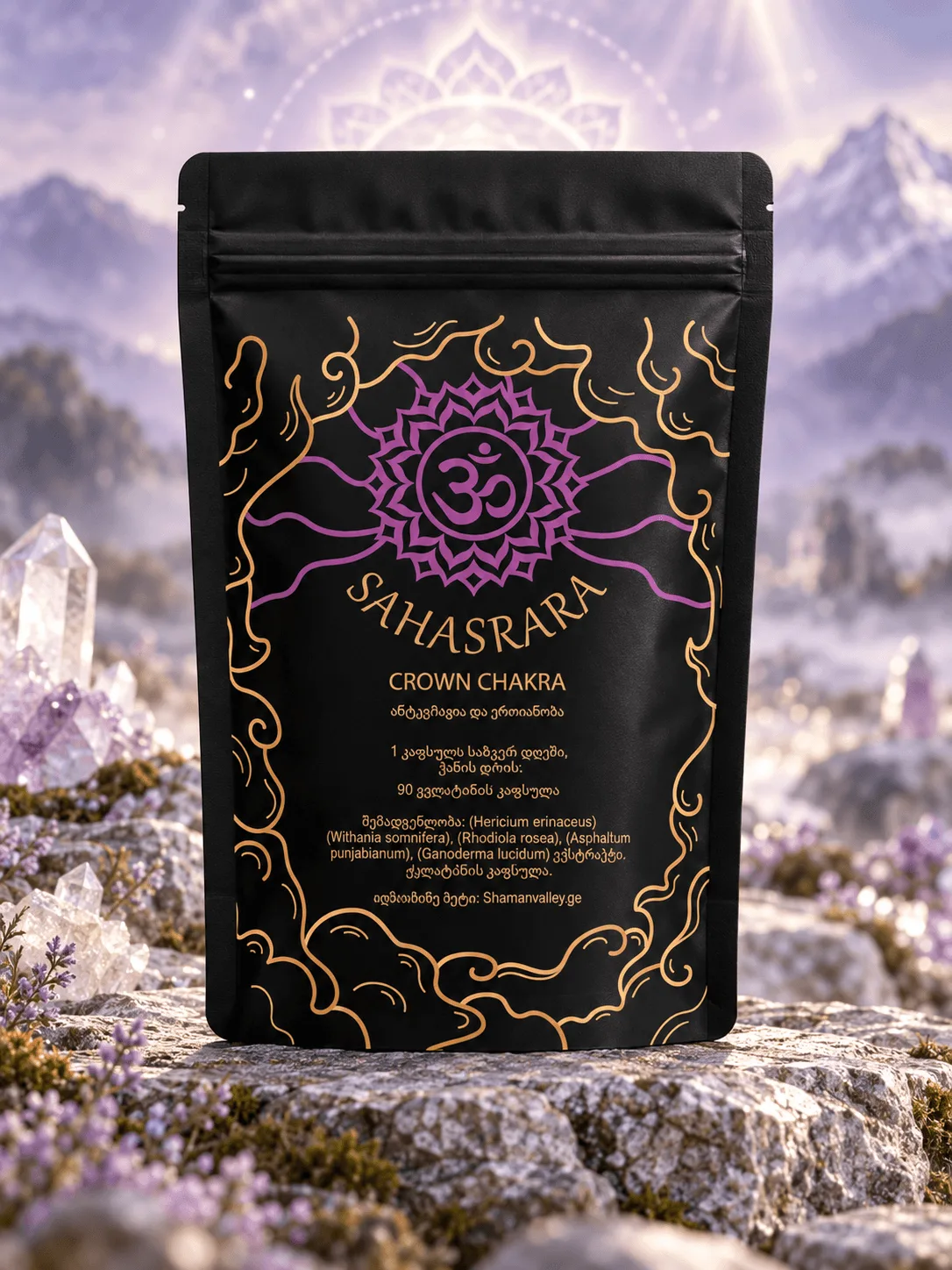
How to Take
Do not use the product in case of individual intolerance or hypersensitivity to any of its components.
Do not use during pregnancy or breastfeeding.
Consult a doctor before use.
Not intended to treat diseases.
Active Substances
Hericium erinaceus — Lion’s Mane
Contains polysaccharides and specific neuroactive compounds, including hericenones and erinacines. These substances support neurotrophic processes, nervous-system plasticity, and the formation of new neural connections.
Withania somnifera — Ashwagandha
An adaptogenic plant rich in withanolides. It acts on stress-adaptation systems and helps maintain a more stable state during prolonged mental and physical stress.
Rhodiola rosea — Rhodiola
An adaptogen whose principal active compounds include rosavins and salidroside. Supports performance, resilience under stress, and recovery during physical and mental fatigue.
Shilajit
A natural mineral-organic complex containing fulvic and humic substances, trace elements, and other organic compounds. Within the formula, it is responsible for energy and recovery resources.
Ganoderma lucidum — Reishi
Contains polysaccharides, beta-glucans, and triterpenes. It complements the formula through immune regulation, adaptation, and maintenance of overall physiological balance.
Detailed description
🔮 The Crown — Symbol of Unity
The Sanskrit word Sahasrara means “thousand-petaled.” In Tantric tradition, it is depicted as an open lotus above the crown of the head — a symbol of a state in which separate parts of experience are no longer perceived in isolation and come together into a unified whole.
Therefore, the Crown symbolizes not another separate ability, but integration. Memory, perception, emotions, bodily impulses, and accumulated experience come together into one inner state from which an overall direction emerges.
The components of the formula reflect the same principle. Hericium is associated with the growth and plasticity of neural networks; Ashwagandha and Rhodiola with maintaining the stability of the system under stress; Shilajit is regarded in traditional medicine as a source of vital resources; Reishi has for centuries been associated in Eastern tradition with longevity, inner balance, and a state of calm clarity.
Different traditions describe this in different words, but the principle is the same: wholeness emerges when multiple processes begin to function as one system.
🧠 Sahasrara: Neuroplasticity, Adaptation, and Systemic Regulation
Neuroplasticity — Hericium erinaceus
Biochemistry:
Hericium contains neuroactive compounds, among which hericenones and erinacines are the best known. They are studied in relation to neurotrophic signaling pathways, including processes associated with NGF — nerve growth factor.
Neurotrophic factors participate in the maintenance of neurons, the growth of neural processes, and the remodeling of synaptic connections — that is, in the nervous system’s very ability to change under the influence of experience.
Effect:
Hericium creates the neuroplastic foundation of the formula — supporting the adaptation of neural networks, learning, and the ability to connect new information with existing experience.
Stress Adaptation — Ashwagandha
Biochemistry:
The principal active compounds in Ashwagandha are withanolides. Their action is associated with stress-response systems, including the hypothalamic-pituitary-adrenal axis, which regulates the body’s response to prolonged stress.
Effect:
Ashwagandha helps moderate excessive stress responses and maintain a more stable functional state during prolonged strain.
Performance and Adaptation — Rhodiola rosea
Biochemistry:
The main marker compounds in Rhodiola are rosavins and salidroside. They interact with cellular stress-response systems, energy metabolism, and neurotransmitter regulation.
Effect:
Rhodiola supports the ability to maintain mental and physical performance under stress and reduces feelings of exhaustion.
Energy Resources — Shilajit
Biochemistry:
Shilajit is a complex mineral-organic substance rich in fulvic substances, humic compounds, and trace elements. Its components are studied in the context of mitochondrial metabolism, energy metabolism, and tissue recovery.
Effect:
Within the formula, Shilajit serves as an energy foundation — supporting physical resources, endurance, and recovery processes.
Immune Regulation — Reishi
Biochemistry:
Ganoderma lucidum contains polysaccharides, beta-glucans, and triterpenoids that affect various mechanisms of the innate and adaptive immune response.
Its action is more accurately understood not as constant immune “stimulation,” but as participation in its regulation and the maintenance of a balanced response.
Effect:
Reishi adds a systemic level to the formula — immune regulation, adaptation, and maintenance of physiological balance.
The Hypothalamic-Pituitary System — Principle of Coordination
Biochemistry:
The hypothalamus receives information about the body’s internal state and generates signals that regulate several endocrine axes through the pituitary gland.
The pituitary gland secretes tropic hormones involved in the regulation of the thyroid gland, adrenal glands, and reproductive system. Therefore, in our model, it becomes the physiological analogue of the principle symbolized by Sahasrara: multiple separate systems are united through common coordination.
Effect:
The formula does not directly “stimulate the pituitary gland.” Its logic is broader — to support several interconnected levels, from neural plasticity and stress adaptation to energy and immune balance.